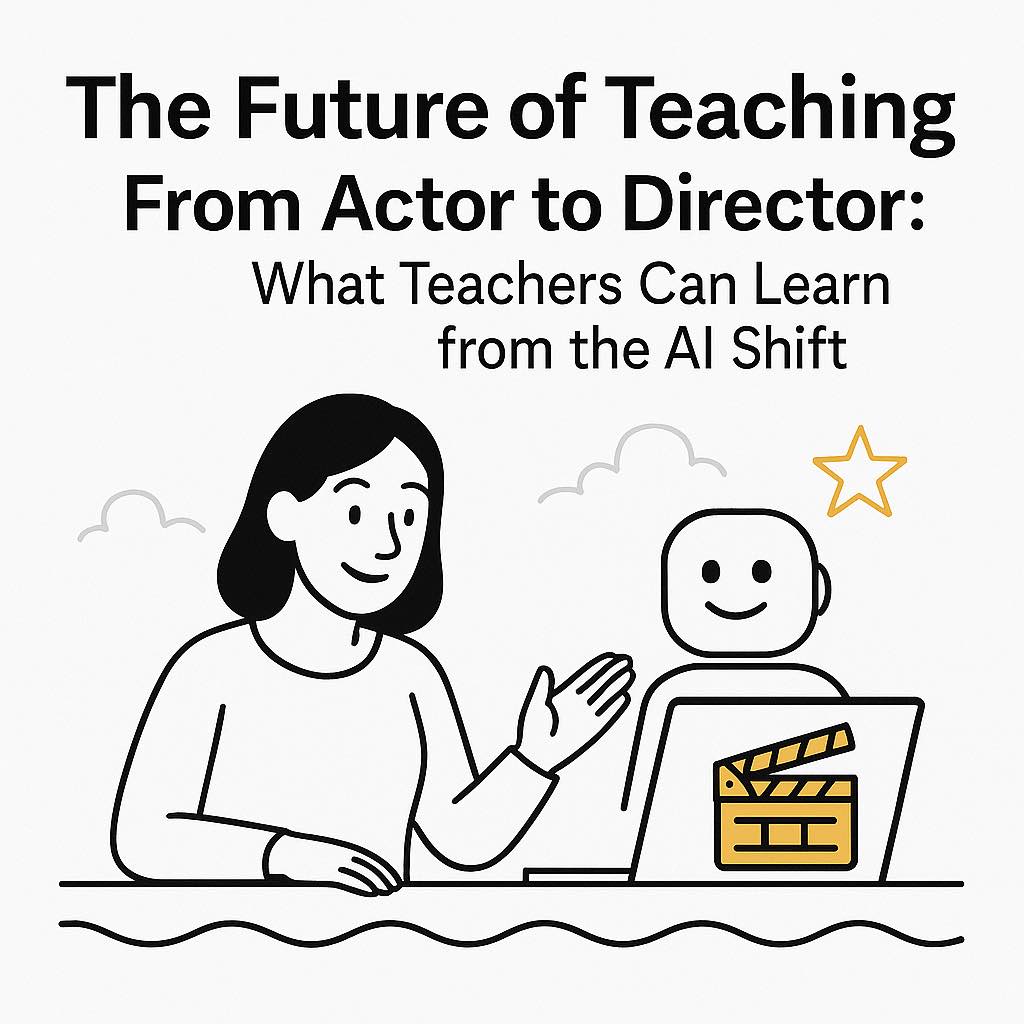
From Actor to Director: What Teachers Can Learn from the AI Shift
Right now, many educators are sitting on the sidelines—unsure, skeptical, or even afraid of what AI might mean for the future of teaching. But beneath the hesitation lies a powerful truth:
AI is not here to replace you. It’s here to amplify you.
This moment isn’t about cutting teachers—it’s about multiplying their impact. Imagine this: What if grading took 15 minutes instead of two hours? What could you create with that reclaimed time? What deeper connections could you build? What new ideas could you explore?
The question is no longer, “What will AI take from me?”
It’s “What could I accomplish with AI beside me?”

1. From Tool to Teaching Partner
AI isn’t just a faster way to write lesson plans or respond to parent emails—it’s a partner that helps you step beyond the daily grind. Instead of spending your time on repetitive tasks, you get to focus on what really matters: inspiring curiosity, nurturing growth, and designing personalized learning experiences.
You’re not losing control. You’re gaining creative freedom.
2. Prompting is the New Superpower
In business, leaders are learning that how you ask AI is everything. The same is true for teachers. Search engines are passive. AI is collaborative.
Instead of searching:
“How to teach photosynthesis?”
Try prompting:
“Act as a 7th grade science teacher. Design a 3-day lesson plan on photosynthesis with storytelling, one hands-on lab, and a final creative project with a rubric.”
Knowing how to talk to AI unlocks its full potential—and yours.

3. From Actor to Director: Reclaiming the Stage
For years, teachers have been asked to deliver scripts—following pacing guides, prepping for tests, covering content written elsewhere.
But now? AI can help handle prep work, generate ideas, and customize materials. That means you step into the role of director—guiding the experience, shaping the story, and leading your students like a cast toward a meaningful performance.
AI doesn’t replace you on stage.
It lets you rise above it—and direct the show.
4. Adaptability Is the New Expertise
In a fast-changing world, flexibility beats perfection. The teachers who thrive won’t be the ones who master one tool—they’ll be the ones who try, adapt, and evolve.
Ask yourself regularly:
“What can I stop doing manually this month?”
Your most valuable skill is your willingness to experiment and grow.
5. Fewer Tasks. Deeper Roles.
Across industries, we’re seeing leaner, more creative teams do more with less. Education will follow. The future classroom may rely less on task-based roles—and more on educators who bring strategy, creativity, and AI fluency to the table.
You won’t be one of 20 doing the same thing.
You’ll be one of five transforming the way learning happens.
6. Don’t Fear the Shift—Shape It
The full transformation of education won’t happen overnight. We’re at the start of a 10-year evolution. But those who step forward now—the ones who learn, explore, and lead—will define what the future of teaching looks like.
Be the educator who:
- Designs lessons powered by AI and empathy.
- Coaches peers on prompt crafting and workflow automation.
- Builds human-centered, tech-enhanced classrooms.
Final Call to Action:
AI is not here to replace great teachers.
It’s here to remove the routine, so great teachers can finally shine.
Be the thinker, not just the doer.
Be the designer, not just the deliverer.
And above all—stay human.
Because that’s the one thing AI can never be.